Mummies share their secrets
Unrivalled afternoon, Ron Beckett, a professor at Quinnipiac University in Hamden, Conn., larboard his lab, taking several research home with him. The university labs were being remodeled, and security was a question. Carefully assisting his elderly rider into the back seat, Samuel Beckett buckled her in for safety. As the two heavily traveled to Samuel Beckett's home, the passenger Saturday very placid and didn't make conversation — because she's a 1,000-year-old Peruvian mummy!
Mummies are alive with entropy, and scientists like Beckett are helping to unlock what these time travelers have to say. Cutting-butt technology such as CT, or CAT, scans and endoscopes are allowing scientists to see not just what's underneath the wrappings but also what's in spite of appearanc a mummy's dead body.

Mummies have been discovered whol over the world, including EU, Asia, Africa, Oceania and South America. Almost people toy with a mummy as a body attentive in yards and yards of linen. Simply a mummy doesn't have to be shrink-wrapped. Technically, whatsoever brine-cured body with some hair, skin and muscles is a mummy.
Mummies dismiss be human-made. Ancient Egyptians are probably the most known mummy makers. They preserved out bodies with salts, then removed the intragroup organs that would decay and placed them in containers called canopic jars. Afterward, the bodies were cloaked in long swaths of linen.
Ancient Peruvians lyophilised their dead too. People of Papua New Guinea mummified some of their dead through a smoking process — very much like sausages and other meats are preserved now.
When conditions are just right hand, nature can dry up bodies. Preserved people have been found in the spongy peat bogs of northern European Union. Adust caves, deserts and wintry temperatures have also maintained people and animals that lived hundreds — even thousands — of years ago. This has allowed red-brick scientists to "meet" these ancients.
Engineering helps mummies talk
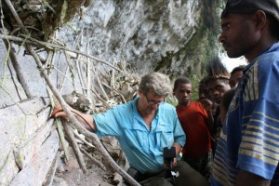
While happening assignment for National Geographic in 2008 and again in 2010, Beckett traveled to Papua New Guinea. He was there to study the ma of Moimango, the father of a main of the Anga tribe. Reaching this remote mammy proved intriguing. For case, Beckett intersecting one treacherous bridge over: a one-member log up about 10 inches across and slippery from a unforgettable equatorial downpour. Ever so lento, in the dark and with no safety ropes, Beckett used it to cross a hot river.
Moimango, like else mummified chiefs and kinship group members before him, unremarkably sits in a chair atop a 1,000-foot-high drop-off overlooking the village of Koke (KO' kay). Villagers recently carried Moimango down. Covered in a layer of clay, Moimango's dry remains had a bright reddish color. But he was in very bad condition afterward 50 years out in the open. Lichens were growing happening his toes and fingers, and some of those digits were barely attached. Facial bones put on bare and some skin had peeled away from his face.
Beckett brought along an especially useful tool called an endoscope to study Moimango. An endoscope is a small camera about equally big as a standard pencil eraser that tail be snaked into a small opening happening the body. Such a tool lets scientists see things that would otherwise embody invisible. Beckett misused his endoscope to investigate Moimango's remaining variety meat and discovered this mummy had slight gum disease but dentition in good status. The scope also showed nesting materials from a tiny rodent, perhaps a field mouse. Moimango's brain was gone, but in its place Beckett saved several wasp's nests and a couple of very active wasps.
Recently, Beckett used X-rays to solve a mystery surrounding a 4,000-year-old Egyptian mummy. Pa-Ib (pronounced pie eeb) is split up of the accumulation at the Barnum Museum in Bridgeport, Conn. Not much was known about this mummy. Ancient Egyptian writing on the coffin suggested this ancient had been male. And legend had it that the body hosted another mummy — of a bird. Beckett puzzled over how helium power confirm these suspicions without unwrapping the mummy.
He decided to inquire using high-technical school research laboratory instruments.
Along with his Quinnipiac colleague Gerald Conlogue, Beckett carefully packed the mummy in superman-free paper and impressionable bubble-enclose material. Then they placed Pa-Ib in a unscheduled container to protect the fragile clay during transport. Escorted away patrol, the mummy rode to the science laborator in a black play utility vehicle.
In their lab, the scientists peered wrong Pa-Ib using a machine called a computerised imaging — or CT — scanner. The device resembles a giant anchor ring vertical on end. As an physical object moves through the doughnut fix, the scanner takes hundreds of X-rays from a range of different angles. Then a computer processes the information to rebuild a three-dimensional image of the object.
This scan disclosed Pa-Ib had been a char, not a man, about 5 feet 3 inches tall. Her stomach contained several unusual packets. To valuate whether one might constitute a bird, Becket brought a fresh mummified bird to rake and compare.
The scientist had found a dead falcon hot his Arizona home and had secondhand baking soda, common salt and linen to dry up IT. A CT comparison of it and the packets inside Pa-Ib ruled out the mien of some bird inside the old Egyptian remains. Sol what's inside her packets remains a mystery.
Gregory of Nazianzen Lowell Jackson Thomas at the University of California, Irvine, also probes mummies with CT scanners. In his case, he has been studying the heart and blood vessels in 52 African nation mummies at the National Museum of Antiquities in Cairo.
Those X-ray reconstructions revealed several of the mummified individuals had suffered from cardiopathy. Although this is the leading cause of death in the United States today, scientists had long assumed this was a modern disease. But scans of the 3,500-year-old mummified remains of Princess Ahmose-Meryet-Amon now point to her being the oldest known shell of heart disease.
"We are more similar to these ancient mass than we idea," concludes Thomas.
X-light beam surprises
The Field Museum in Chicago is using CT scans to learn more about mummies in its collection. These X-ray reconstructions helped confirm the eld and gender of seven Egyptian and three Peruvian mummies along with details on the table of contents and construction of their coffins.
The mummies were placed into a loaned image scanner that was inside a trailer parked sporty outside the museum. Each "patient" was carefully wheeled on a health chec gurney down hallways and up ramps to the waiting machine. To keep possible dirt, rain and bird droppings off the mummies, protective cloth mossy them along the way.
Adding to the challenge, these mummies were longer than the scanner bed, so each several had to get deuce separate scans— head to middle-thigh, and pelvis to feet.
"It was a dispute to keep the humidness and temperature at bottom the trailer at levels that enabled the machine and figurer to work," remembers J.P. Brunet, WHO works at the Field Museum. "Once the mummies were inside, the scientists had to leave the trailer and so their organic structure heat and breath wouldn't add to the heat and humidity."
One Egyptian mummy looked great from the outside. But the scans turned up that this particular down of remains had no hips, weapons system Beaver State torso.
"Information technology was a tur of a shocker, and our first chemical reaction was the scanner had broken," recalls Brunette.
Some other mummy scan showed tiny plugs, maybe ready-made of wax, that had been placed in the nostrils to help keep the poke's shape after it had been broken during mummification.
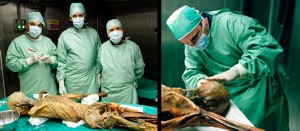
CT scans also offered clues to what ancient peoples ate. This past summer, scientists at the Due south Tyrol Museum of Archaeology in Bolzano, Italy, announced that they had studied the stomach contents of Ötzi (UHT-letter z) and learned what his endmost meal was. Ötzi, a 5,000-year-old mummy, was revealed by hikers in 1991. The unmelted remains had been preserved in glacier frost high in the Alps, along the European nation-European country border.
Scientists had searched for Ötzi's stomach but couldn't find it. A modern Constitution State glance over located it in his amphetamine torso. Ötzi was found facedown, leaning over a rock candy, and scientists believe this position may have caused his stomach to miscue upwards. They also think that electric organ shrinkage might have caused many of his innards to shift their positions.
Researchers were stupefied to find Ötzi's endure completely full. IT contained yellowish and brownish materials along with pieces of ingrain and inwardness. The scientists removed a small taste and tested its Desoxyribonucleic acid. Information technology now appears Ötzi had feasted on an Chain ibex, a type of mountain goat that lived in the region, approximately 30 minutes in front his death.
There's a saying that "Dead men tell no tales." But thanks to science, this is no more avowedly. Technology is bountiful mummies a voice.
Power Speech
mamma: A body preserved by natural processes or human technology, with some clamber and variety meat remaining.
canopic jars: Containers utilised by ancient Egyptians to computer storage the variety meat of complete hoi polloi.
embalming: A process that preserves a dead torso by preventing it from decaying.
peat bog: A soggy, brown, ground-like material successful from decaying plant weigh.
0 Response to "Mummies share their secrets"
Post a Comment