Best Way to Record Negative Reviews of Home Security System
For the past few months, I've been letting Ring—and, by extension, Amazon—monitor my house.
When no one'due south habitation, the Ring Alarm arrangement keeps watch through a system of contact and motility sensors, ready to ship alerts to my phone—and, optionally, to a professional monitoring service—if the sensors find an unwelcome presence. Meanwhile, Amazon'south Echo speakers provide extra protection, letting me arm and disarm the system past voice and listening for the sound of smoke alarms or broken drinking glass.
If I wasn't using a Ring Alarm system on loan from the visitor, it's the kind of matter I might've already bought for myself—perhaps during Prime number Twenty-four hour period or the many other occasions when Amazon puts the product on deep disbelieve. Even at a regular cost of $199 for an entry-level kit, information technology undercuts competitors like Nest and ADT by hundreds of dollars, and it's more reliable than cheaper do-it-yourself systems that lack cellular and battery backups. Information technology is, in short, a great production, and information technology's ane that Ring CEO Jamie Siminoff tells me is primal to the company'south futurity.
"We do believe it really is a core, foundational slice of our overall long-term vision and mission to protect and keep our neighbors safer," Siminoff says in an interview, which Ring set upwards to discuss the company'south strategy around alarm systems.
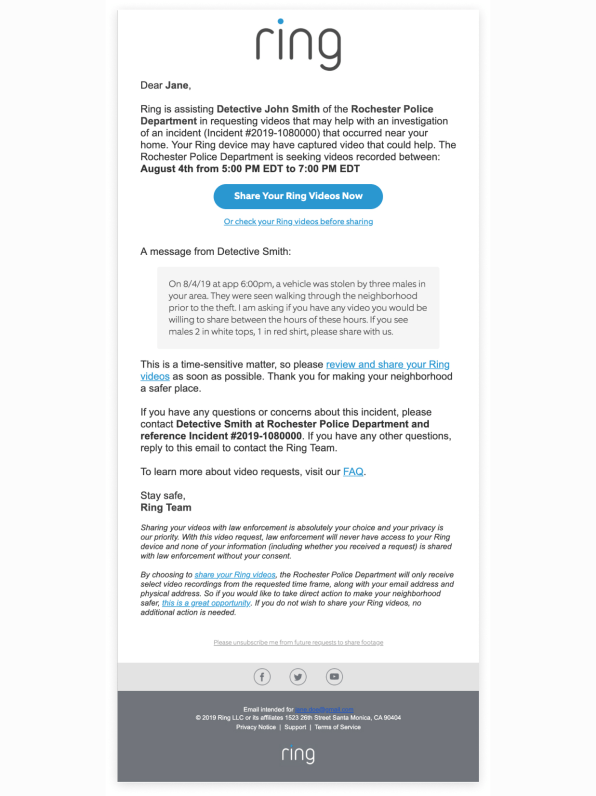
At the same time, it's hard to reconcile my appreciation for the Band Alarm with my unease about the company behind information technology. Even as criminal offense rates hit record lows, Ring has convinced millions of people to surveil their holding through doorbell cameras, and it'due south at present helping police force departments around the country enquire residents for warrantless admission to the footage. Meanwhile, Band's Neighbors app provides an open forum in which people tin can hash out threats—both real and perceived—in their communities, risking heightened paranoia over whatever their cameras are dredging up.
The Ring Warning, despite all its virtues, is a natural extension of those efforts. If using Ring's camera and Neighbors app puts y'all on edge, an alert system is just the thing to restore peace of mind. Only buying into that system feels unsettling, no matter how well it actually works.
Knowing when you're home
Compared to a traditional security system, the most attracting aspect of the Band Alarm is that it doesn't feel like a huge commitment. The base price of $200 is pretty depression for home security, and the $10 per month home monitoring service isn't mandatory. Even without it, yous'll all the same become a blaring siren at home and alerts on your telephone during a potential intrusion. (You even get a window sticker to ward off prospective burglars.)
Setting the system up isn't much of a hassle, either. You take to connect the base station to Wi-Fi on your ain, but all the other components are paired out of the box. All you have to practise is mount the contact sensor to a door or window and figure out the all-time place to put the motion sensor.
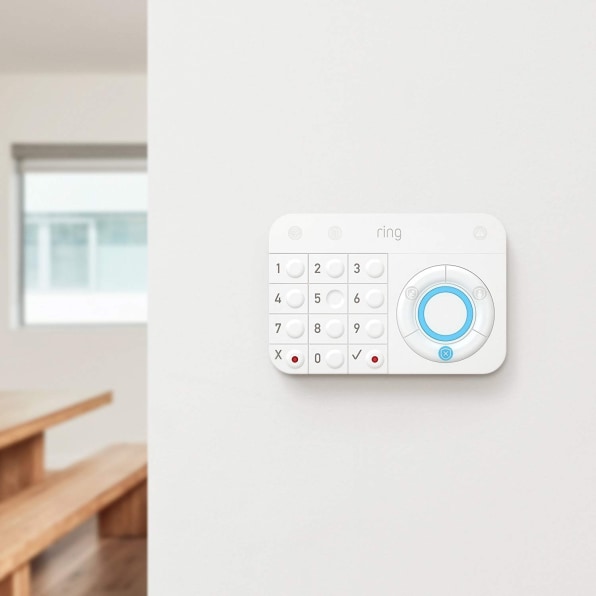
Band won't provide sales figures for the alarm system—at most, the visitor says information technology has millions of users across all of its products—but Siminoff points to thousands of Amazon reviews with an average 4.5-star rating as a sign of success.
"Past delivering affordability, usability—having it equally easy as it is—and then the peace of heed of what it does for you, I think all of these things together are why it's doing so well in the marketplace," he says.
Ring isn't simply trying to sell warning systems, though. It's also hoping to build an ecosystem effectually them, with add-ons similar fume and carbon monoxide detectors, and tie-ins with other companies' smart lights, door locks, and other devices under the "Works with Band" programme. Long-term, Siminoff envisions a platform that can work automatically on behalf of users, changing the state of the home based on whether they've armed or disarmed their systems.
Information technology's all part of a broader shift for the company, Siminoff says, away from a singular focus on reducing crime, and toward increasing safe overall. That mission is also what distinguishes Band's smart-dwelling efforts from those of Amazon, which has built a broader platform around its Alexa phonation assistant.
"In that location are things on my list that people have never done before in this expanse," Siminoff says. "A large part of that innovation will come up from things similar the Band Alarm having state [awareness], to be able to build these next-generation products and services that will make our neighbors safer."
Pushing private surveillance
The smart-habitation nerd in me thinks all of this sounds nifty. The state of an alarm system is a pretty good proxy for whether its users are abode or not, and from that bit of insight a lot of clever automations can spring forth. Ring's strategy around abode and abroad states reminds me of what Nest was building through its "Works with Nest" programme, which languished afterward Google acquired the company in 2014. (Google is now trying to fold Nest's previous integrations into its own "Works with Google Banana" program, which presently revolves more around voice interaction.)
But at a time when tech companies are intent on locking you lot into their respective smart-home platforms, investing in any 1 of them requires a sure degree of trust. Personally, I'k wary of a company that quietly encourages police departments to help sell more than doorbell cameras, coaches said departments on the best mode to convince residents to plough over their photographic camera footage without warrants, dictates what those departments should and shouldn't say publicly, and wraps the details of those partnerships under confidentiality agreements. The overall picture is of a visitor that is pursuing growth at the toll of privacy, largely out of the public eye.
In its defense force, Band says that police force can't access any Ring footage without getting explicit permission from the camera owner every time, and that information technology doesn't share customers' data or exact location with constabulary while passing along these requests. The idea is that police won't know if a specific Ring photographic camera owner has refused a request for footage. Still, Gizmodo recently reported that Ring had been sharing information on how many users rejected footage requests—a exercise that Ring says it's now abandoned—and that police force accept found their own ways to identify Ring users.
In whatsoever case, the larger concern remains: Ring has created a organisation that facilitates more individual surveillance in the beginning place, and it's moving so quietly and apace that the public doesn't get much adventure to wrestle with the implications.
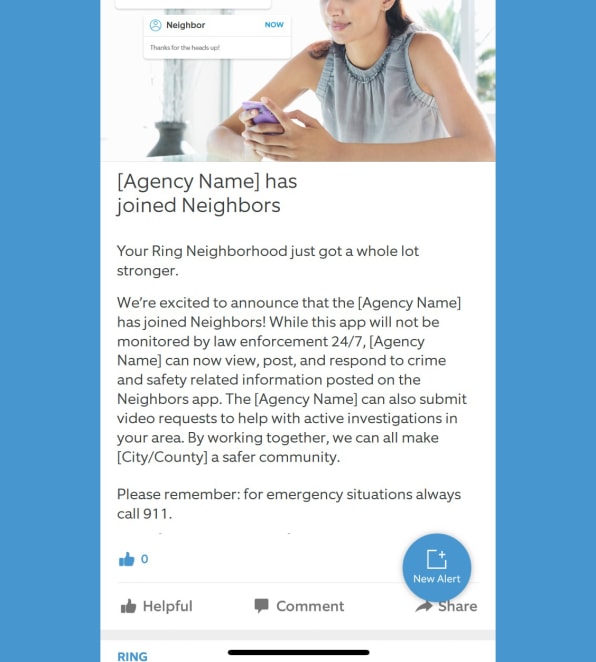
Ring seems to have realized that information technology can't get on like this. Later on months of records requests and reporting on Ring'south activities by Vice Motherboard, CNet, Gizmodo, and Wired, among others, the company is making grander gestures toward transparency. It now publicizes the number and location of police partnerships it has around the state, and it at present tells residents via its Neighbors app that these partnerships let police to asking doorbell camera footage. Eric Kuhn, the general director of Neighbors, says that Band will begin emailing users about these partnerships likewise, rather than merely sending out letters through Neighbors.
"Nosotros've tried to make it as transparent as possible," says Kuhn. "We'll continue to make it more transparent."
Kuhn also acknowledges that confidentiality agreements with police force departments are no longer tenable given that they'll turn up in public records requests anyway. He claims that previous agreements demanding confidentiality were "boilerplate" and the issue of standard industry practices.
"Those agreements volition evolve over time, and that clause is, I think, one that is not really necessary," he says.
Same fear, slicker package
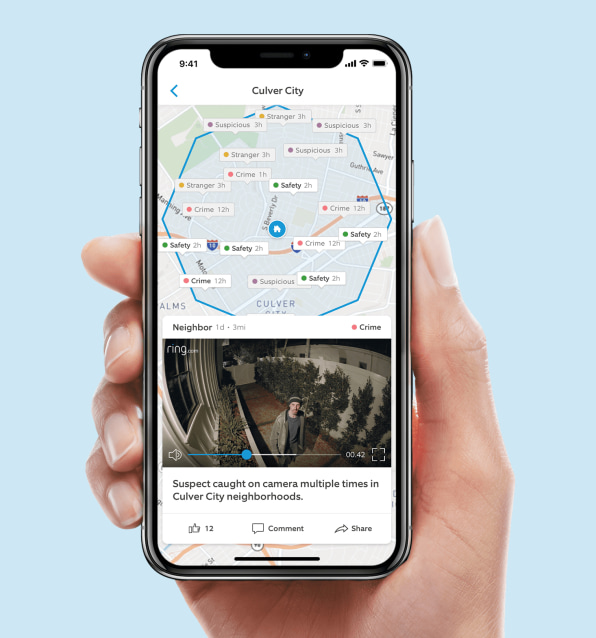
While the Ring Warning organization runs parallel to the company'southward doorbell photographic camera business, it besides arguably completes a virtuous cycle that starts with people surveilling their property. Thank you to Ring'due south Neighbors app, people who own Band doorbell cameras tin share their footage and ask others in their community for advice. Band, in plow, has used the app as marketing fodder, sharing footage of alleged criminals in Facebook ads and hiring editors to create neighborhood crime alerts. Come across enough of these alerts, and you might start thinking that an alert system is essential.
Siminoff pushes dorsum on the idea that Ring is using fear to sell alarms. Compared to traditional warning ads, he argues that Band's marketing isn't about every bit hysterical considering it relies on bodily crimes that Band has prevented. (And looking at some ADT ads from a few decades agone, he has a point.)
"We've always tried to use real examples of what we've done without trying to hype the law-breaking up to do that," Siminoff says.
But but because the crimes are real doesn't mean that people are getting an authentic sense of the danger level in their communities. The problem with an app similar Neighbors is that it inherently focuses on criminal offence and other negative events, rather than providing a more than balanced view of what's happening effectually them. This could farther convince people that crime is more prevalent than it actually is, in the same way that crime-heavy local news reporting makes people experience disproportionately threatened.
Ring's Eric Kuhn argues that the Neighbors app highlights more just crime, pointing to posts about finding lost pets, returning lost items, or—in one instance—a neighbor helping a family unit escape a house later it defenseless fire. He too says Band has tried to dial down paranoia with new guidelines that users must concur to before posting. Ring has been encouraging users to focus more than on beliefs, rather than individuals or their appearance, and its guidelines now explicitly preclude racial profiling. Every video post also requires approval by a human moderator.
"At that place is a lot of good being posted in Neighbors. We hope that it continues that fashion," Kuhn says.
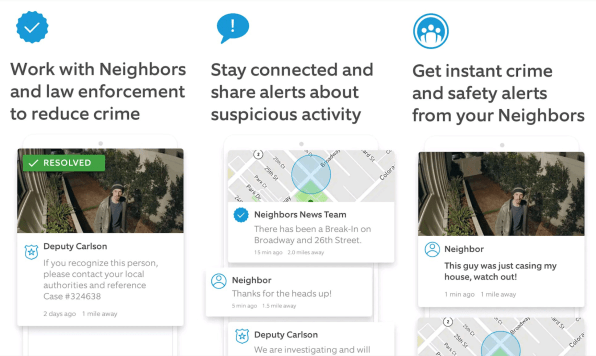
Even then, Ring will non disembalm the proportion of posts in Neighbors that aren't crime-related, and the app store listings for Neighbors lay bare the app's primary purpose: "Stay connected and share alerts about suspicious action," says one promotional image. "Piece of work with Neighbors and constabulary enforcement to reduce crime," says another. Lost pets and personal belongings don't go a mention.
Doing the right things
Partway through my conversation with Siminoff, he said something that stuck out to me. We were discussing competition with other alert systems, and he began talking most how Ring is ultimately guided past what its customers want.
"If nosotros make our neighbors' lives improve in their homes, make their neighborhood safer, they will advantage united states with their money," he says. "People don't buy a Ring product, they advantage us by taking that production into their home considering they know that what they're doing is going to make their lives better."
That comment, I call up, gets to the core of my unease about Ring: Customers, for the near role, seem to love the production and are undeterred by contempo reporting about Band's actions. Amazon says it sold twice equally many products from Ring and Blink (its other security camera brand) during Prime Day this yr than it did the year before, and the Neighbors app currently holds four.7-star and 4.vi-star ratings on the iOS App Store and the Google Play Store, respectively.
Considering Ring isn't getting blowback from customers, information technology tin easily overlook the downsides of what information technology's doing. This is the same design nosotros've seen with other tech companies such as Facebook and YouTube, whose ever-increasing revenues and appointment seemingly blinded them to their products' negative implications. In the case of the Band Alarm, the push button to provide peace of mind could paradoxically be creating more anxiety virtually crime and injury, all in service of turning what could be a niche business organisation into a mass-market production, worthy of a tech behemothic similar Amazon.
I'm reminded of this every week, when Ring delivers a local "crime written report" to my telephone. Looking over the map of my area reveals all kinds of threats, from theft to assault, suggesting that the Band Alarm would be money well spent. But upon closer inspection do I discover that the written report casts far too broad a geographic cyberspace. Zooming in on my neighborhood and its surrounding areas reveals that in that location's actually nothing to worry about.
Source: https://www.fastcompany.com/90397950/rings-smart-home-plans-would-sound-great-if-ring-itself-was-less-frightening
0 Response to "Best Way to Record Negative Reviews of Home Security System"
Post a Comment