Is culinary cultural appropriation a thing in multi-ethnic Singapore?
In multi-indigenous Singapore, culinary cultural appropriation tin can be a complex field of study. A nation forged from multiple diasporas, Singapore is, as the old trope goes, "a melting pot" that has birthed a unique national culture far richer than the sum of its parts.
We mix Maggi with mala, fish heads with curry, and stuff rice dumplings with chicken rendang (yes, really), all in the proper name of our obsessive gastro-culture. And then it can be hard to encounter the line betwixt culinary cultural appropriation and evolution. Or is there a line at all?
Dorsum in the 18th and 19th centuries, as Singapore blossomed into a hub of entrepot trade, our ancestors were too busy building a life to concern themselves with what they should wear, cook or eat in social club to express and safeguard their cultural identities as Indians, Malays, Chinese or Eurasians. They just were who they were.
Some became Peranakans (or Straits-born) past virtue of whom they married and the period during which they were born. This cultural group, particularly, assimilated in the most maximalist of ways. They adopted and gilded the kebayas of the Southeast Asian islands, borrowed from the flavours of their neighbours' cuisines, and learnt to speak the English language of the colonial masters. From these influences they designed a colourful, multi-faceted culture that is today proudly celebrated as all that is appealing about Singapore as a destination.
"We mix Maggi with mala, fish heads with curry, and stuff rice dumplings with chicken rendang (yes, really), all in the proper name of our obsessive gastro-culture."
DOES THAT NOT MAKE PERANAKANS THE ORIGINAL CULTURAL APPROPRIATORS OF THE COUNTRY?
To agree with that would be to say that everyone else was complicit in stealing from each other'due south culinary cannons. Cuisines are built-in of nostalgia, necessity and innovation; a demand to recreate family flavours in a new state and an urge to bring a taste of faraway lands to our own homes. They are a product of our experiences and memories, a living, animate expression of our expansive identities.
The early Chinese and Malays didn't grow up on laksa or otak-otak or many of the other dishes distinct to Singaporean culture today. These foods are the result of migration, cultural crossovers, friendships and innovation. Singapore'due south cuisines were literally built on those pillars.
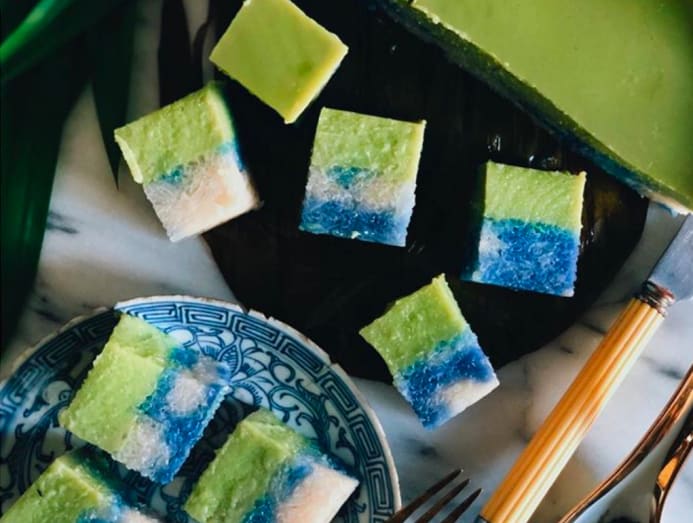
Sensitivities arise, even so, when i civilization'due south traditions are side-lined or substituted for some other's in the proper noun of a national narrative. Kueh, for case, is as much a Malay culinary tradition as it is a Peranakan or Chinese one.
All the same kueh is largely showcased as a Peranakan custom. "Take kueh salat or ondeh-ondeh," said Azimin Saini, founder of Tempeh Civilisation. "The Malays take been making information technology for years, but in the terminal couple of years, they have become synonymous with Peranakan desserts. Why is that, when so many other cultures make ondeh-ondeh, even if it is called past a different name?"
READ> Creative Capital: The foodie bringing communities together with tempeh
PUT YOUR STAMP, Non YOUR LABEL, ON It

This simmering distaste for the overlooking of Malay culinary culture for the more than colourful mixed handbag of the Peranakans' came to a head earlier this month when Violet Oon Singapore began marketing a Nyonya Nasi Ambeng Family Tray.
READ> Violet Oon restaurant apologises for 'nasi ambeng' dish later cultural appropriation claims
Nasi ambeng is a traditional Javanese dish served at of import occasions like weddings and Ramadan, and eaten after religious celebrations. It is a lavish, communal platter of steamed rice and dishes like chicken curry, sambal goreng (spicy fried tempeh and long beans), beef rendang, urap (a vegetable and coconut dish) and lots more.
"Nasi ambeng is time-consuming and labour-intensive, which is why it is hardly available outside of homes. It is a civilisation we, the Javanese diaspora, continue to preserve. To suddenly see information technology labelled equally Nyonya really hit a raw nerve amongst the Malay community," explained Azimin.
Violet Oon Singapore afterward apologised for having "insensitively used the name of a symbolic dish for a Nyonya interpretation that failed to articulate or acknowledge the rich significance and origins of Nasi Ambeng which originated from Coffee, Republic of indonesia".
In Saini'due south view, there is a firmly drawn line between assimilation and cribbing.
"I think we need to exist conscious of whether you are erasing someone's culture when you create or label a dish," he stressed. "When you create pork belly buah keluak biryani, for example, you're not taking away annihilation from anyone; you're just creating something new. Only if nosotros get out the labels such as Nyonya Nasi Ambeng as they appear, then you lot'll eventually have a generation of people who recall nasi ambeng or kueh salat are solely Peranakan dishes."
"I think nosotros need to be conscious of whether you are erasing someone'south culture when you create or label a dish."
R.E.S.P.Eastward.C.T
What lies betwixt cultural assimilation and appropriation, then, is sensitivity. Cultural cribbing is widely defined as when a dominant civilisation adopts the cultural customs of a non-dominant civilization without agreement or respecting the original culture and context, and and so profiting from it. Does that mean you can't make bak chor mee because you're non Chinese? No, of course not. Just enquire the guys from Li Na Fishball Noodle.
"Does that hateful you can't brand bak chor mee because you're not Chinese? No, of form non."
In numerous restaurants, chefs have created cuisines that are a celebration of various cultures. In Singapore, many fine-dining restaurants lean on the refinement of European and Japanese influences to create pricey tasting menus that diners are more than willing to fork out for.
In mixed-race homes, too, new cuisines are being created every day. One couple of Indian and Mexican descents recently told me that they had created their own sub-cuisine they've dubbed "Indimex", just by cooking together in their dwelling kitchen.
Ultimately, food – especially in Singapore – is a binding force. Information technology brings us together in a fashion that no Racial Harmony Solar day action ever could.
Nosotros may all live our own cultural traditions, just nosotros also constantly make new familial ones unique to our kith and kin. My grandmother made buah keluak like any other Peranakan matriarch, except she insisted that that buah keluak should only be fabricated with pork, never chicken (yes, I tin hear the other bibiks scoffing).
My mother carried on this tradition and served you char kway (never "yu tiao" because Standard mandarin was barely spoken back in their day), on the side. This manner of serving the dish is probably traditional to no one else just the states.
All this means is that as nosotros evolve, travel, grow and are exposed to other cultures that we eventually come to cherish in our daily lives, our cultural barriers volition continue to blur. Haven't we already come to cover laksa pesto pasta or prata sausage rolls?
And so permit's eat what nosotros enjoy, cook the food of other cultures and share them as widely equally possible. The but pre-requisite for said enjoyment is respect. Respect for the dishes' provenance and for the people who cook them. And never, always claim something that'south not your own. Is this non a bones tenet to live by in all aspects of life?
"Permit's eat what we savor, cook the food of other cultures and share them as widely every bit possible. The just pre-requisite for said enjoyment is respect."
READ> In one case 'fast nutrient' for farmers: How rice dumplings have evolved over the years
Source: https://cnalifestyle.channelnewsasia.com/experiences/is-culinary-cultural-appropriation-a-thing-in-singapore-247906
0 Response to "Is culinary cultural appropriation a thing in multi-ethnic Singapore?"
Post a Comment